

There is a strong likelihood that a meeting between the leaders of three major powers—Vladimir Putin, Xi Jinping, and Donald Trump—will take place in Shenzhen in three weeks. The news is undoubtedly striking. The possibility of such a meeting has been discussed for some time, but until recently remained primarily at a theoretical level. Now, we can state with certainty that the countdown has begun: on November 18 or 19, the three leaders could meet on the sidelines of the annual APEC summit.
The impact of a meeting that has not yet occurred
Despite the interest in the topics that will be discussed, this is not the most significant element at present. The reason is that the first impact of a meeting that has not yet taken place is already evident. And this impact is itself particularly important: the West—and primarily Europe—appears shocked, disheartened, and enraged. Westerners are intensely bothered by the very prospect of a tripartite summit. They do not hide their indignation but express it openly, effectively reaching the point of demanding its cancellation as part of ongoing geopolitical shifts.
Fear of a "new Yalta" and the division of the world into spheres of influence
As it appears, in their eyes, the prospect of a "new Yalta" is taking shape—meaning a division of the world between three major powers, analogous to what occurred in February 1945 during the meeting of Joseph Stalin, Franklin D. Roosevelt, and Winston Churchill. Westerners do not seem bothered by the absurdity of this comparison, even though neither the geopolitical situation nor the relations between the three powers nor the current agenda share anything in common with the conditions prevailing during the final year of World War II.
Furthermore, there does not seem to be a common enemy, although the particularly negative reaction of certain circles to the agreement for holding the meeting raises questions. After all, those who appear most dissatisfied and protest most loudly are supporters of maintaining the existing global order, which was constructed by the Anglo-Saxons and serves their interests. This is the core message of Atlanticist propaganda: the three leaders will gather in Shenzhen and divide the world. Even if they do not divide it, however, the development is still considered negative. As typically highlighted: "Even a single group photograph of the three will become a symbol of the era in which the old global order definitively passes into history."
Europe fears being left outside the new geopolitical balance
The above passage comes from an article by Steve Bloomfield in The Guardian newspaper. The entire text could serve as a condensation of the fears dominating Europe, which, due to its long-standing habit of presenting its own views as universal, presents them as a global concern. According to this approach, the "Big Three" will divide the world into spheres of influence, leaving Europe on the sidelines. However, as Bloomfield sorrowfully points out, just ten years ago the three poles of the world were considered to be the United States, China, and the European Union. Today, however, "somewhere along the way, Brussels has been replaced by Moscow."
The reality behind the global division scenario
It is simply impossible to imagine a real division of the world between the three powers in Shenzhen. However, Bloomfield presents the scenario with remarkable certainty, as if a new world map has already been drawn. According to this version, the United States would acquire the Western Hemisphere, Russia would take the entire post-Soviet space, and China would gain control over the East and South China Seas. Yet this is far from constituting a division of the entire world. In reality, these are the primary areas of interest of the three states, where, in fact, they face numerous competitors among regional powers.
From territories to supply chains, technology, and energy
Bloomfield intensifies his argument, contending that the division will not concern territories alone. The US and China will delineate supply chains and technology platforms, while energy resources carry decisive significance for Russia. At the same time, space constitutes a critical domain for all three powers, for both peaceful and military uses. In other words, it is not only the political map of the world that will change, but also the allocation of economic influence. However, it is not explained how such an outcome could be achieved, given the massive contradictions and competition between the US and China for specific resources and markets.
What Europeans truly fear regarding Ukraine
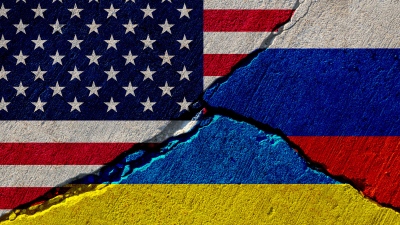
What is it, however, that frightens Europeans so intensely? At this point, the argument is stated clearly: "This scenario poses a particular danger for Ukraine and Europe." As specifically noted: "If the US stops guaranteeing the security of European countries, they will find themselves facing the threat of increased Russian pressure. [...] At the same time, European leaders are not yet ready to fully recognize the extent of the changes taking place [...] and continue hoping that all that is needed is to wait until Trump's presidency is completed and the old order is restored." This highlights deep anxieties over the future of European security.
"Trump will hand Ukraine to Putin" — The real stake for Europe
Essentially, for Europeans, everything boils down to the scenario that "Trump will hand Ukraine over to Putin." In reality, however, the core issue is that, without American support, Europe will not be able to maintain control over Kyiv for long. This, however, has been known for a long time, even without any summit of the "troika." Therefore, it makes no sense to raise the issue of a "division of the world." Neither is it a question of a mythical division, which, naturally, will not take place at the Shenzhen summit, nor a real division, which does not arise through agreements between leaders, but as a result of actual processes reshaping the global order and leading to the collapse of five centuries of Western dominance.
The world has already changed — The summit as a symbol of a new era
The world has already changed, and the meeting of the three leaders in Shenzhen will serve as a clear symbol of this reality. Nothing more and nothing less, marking a definitive shift in international relations.
www.bankingnews.gr

Σχόλια αναγνωστών